Monopoly Casino Financial Risk Assessments
What the UK checks actually are, the exact net-loss thresholds that set them off, what a licensed casino may ask you for, and what to do when your account goes quiet.
A financial risk assessment is a background credit-data check that a UK-licensed casino runs once your net losses cross a set line. It looks for signs of serious financial trouble, not at your salary, and for most players it happens invisibly. This page sets out the thresholds as they now stand, what a casino is allowed to ask you for, and what to do if your account is restricted while one is in progress.
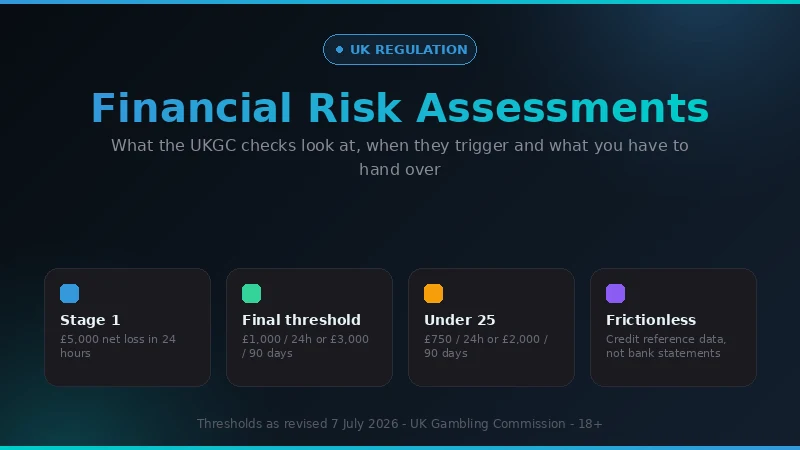
The rule, in plain terms
The Gambling Commission's licence conditions require operators to spot customers who are losing money they cannot afford, and to act before it becomes a serious problem. For years this was left to each operator to interpret, which produced the situation everyone hated: one site would let somebody lose four figures a night without comment, another would demand three months of bank statements after a £200 losing run.
The financial risk assessment framework replaces that guesswork with a fixed trigger and a fixed data source. When a player's net loss on the account passes the threshold, the operator sends the player's details to a credit reference agency and gets back a small set of indicators: is there an active bankruptcy or debt relief order, a recent county court judgment, a pattern of defaults. It is a soft search, and it does not look at income.
Two things follow from that design. First, the check is meant to be frictionless — the player is not contacted, nothing is uploaded, and play continues normally. Second, it is a blunt instrument by design: it is looking for people already in visible financial distress, not for people spending more than a spreadsheet says they should.
Net loss, not turnover, is the measure. Recycling a £500 bankroll through £8,000 of spins over a weekend and finishing £300 down is a £300 net loss, nowhere near any trigger. This trips people up constantly, because the number in your head after a long session is usually the amount staked rather than the amount lost.
The thresholds, as revised on 7 July 2026
The framework is being phased in, so there is a high starting trigger and a lower end-state trigger, and a separate, tighter set of figures for players under 25.
| Stage | Aged 25 and over | Under 25 | What happens |
|---|---|---|---|
| Stage 1 (introductory) | £5,000 net loss / 24 hours | £5,000 net loss / 24 hours | Frictionless credit-data check, no contact with the player |
| Final — 24-hour trigger | £1,000 net loss / 24 hours | £750 net loss / 24 hours | Frictionless check; escalation only if it cannot complete |
| Final — 90-day trigger | £3,000 net loss / 90 days | £2,000 net loss / 90 days | Same check, on a rolling window rather than a single session |
| Escalated review | Triggered by the outcome, not by an amount | Documents may be requested; deposits usually paused meanwhile | |
Rolling windows, not calendar ones
The 24-hour and 90-day windows roll continuously. They do not reset at midnight or on the first of the month, and a losing Friday night stays inside the 24-hour window until the same time on Saturday. Planning around a reset that does not exist is a good way to be surprised.
What this means for you as a player
Three different experiences, depending on where you land.
You never reach a threshold
Which is where the overwhelming majority of accounts sit. Nothing happens, nothing is checked, and nothing appears on your credit file. Depositing £10 at a time and playing the free spins does not put you within sight of any of these numbers.
You cross a threshold and the check passes
Also nothing, from your side. The operator runs the soft search, gets no distress markers back, and play carries on uninterrupted. You are not told, because telling you would defeat the point of a frictionless check.
The check cannot complete, or returns a marker
This is the case people actually notice. Deposits get blocked, a message appears in the account, and the operator asks for something — normally proof of identity or address first, and financial documents only if the data genuinely will not resolve. Withdrawals of your existing balance should stay open throughout.
The most common reason a frictionless check fails outright has nothing to do with money: the details on the casino account do not match the details on file at the credit reference agency. A maiden name, a flat number written differently, a recent house move that has not fed through yet — any of those can return a no-match, and the operator then has to escalate because it cannot do anything else.
If you are thin-file — no credit cards, no loans, recently arrived in the UK, or simply young — the same thing can happen for the opposite reason. There is not enough data to say anything either way, so the frictionless route fails and a manual route opens.
The other checks that still apply
Financial risk assessments are one layer. They do not replace what was already there, and mixing the layers up is why people think the rules contradict each other.
Light-touch vulnerability checks
Triggered by net deposits rather than net losses, at levels far below the risk-assessment thresholds. These look for public records of severe financial difficulty and, again, run in the background. They are the reason an account can be flagged after a few hundred pounds of deposits.
Customer interaction duties
Operators must watch for behavioural markers of harm — chasing losses, session length climbing, deposits at unusual hours, cancelled withdrawals — and intervene regardless of any threshold. Cancelling a withdrawal to keep playing is one of the strongest signals there is.
Identity and age verification
Required before you can deposit at all, and separate from anything financial. If a payout is held pending "verification", this is usually what is meant. See the account and login guide for what gets accepted first time.
Source of funds
A money laundering obligation, not a harm one. It bites on large deposits or unusual funding patterns and can require documents no matter how comfortably you can afford the play. Different rulebook, same inconvenience.
Stake limits sit alongside all of this too: online slots are capped at £5 per spin for players aged 25 and over and £2 per spin for those aged 18 to 24. That cap is unrelated to your finances — it applies to everyone in the age band, on every UKGC-licensed site.
What to do if your account is restricted
1. Find out which check it is
Ask support, in writing, whether the hold is an identity verification, a source-of-funds request or a financial risk escalation. The three need completely different responses and support will not always volunteer which one applies.
2. Check your details match your credit file
Name spelling, date of birth, and the exact format of your address. You can see your own file free with any of the three main agencies. A mismatch here fixes more escalations than anything else on this list.
3. Send the smallest sufficient document
If financial evidence is genuinely required, a single recent payslip or one month of statements usually satisfies it. You are entitled to ask why a document is needed, and to have anything you send handled under data protection rules rather than kept indefinitely.
4. Withdraw first if you want out
A deposit block does not normally block withdrawals. If you would rather not go through the process, request the balance and let the account sit. Verification of identity still has to clear before the money leaves.
5. Escalate properly if it stalls
Operators must have a complaints procedure with a final response. After that you can take it to the alternative dispute resolution body named in the terms. The Gambling Commission does not adjudicate individual disputes, but it does want to hear about patterns.
How we got here: the timeline
April 2023
The gambling White Paper proposes a two-tier system of checks, with frictionless assessments at the higher tier, explicitly to end the era of operators demanding bank statements at wildly different points.
August 2024
Light-touch financial vulnerability checks go live on net deposits, and the pilot of frictionless financial risk assessments begins with credit reference agencies and a group of operators.
February 2025
The light-touch trigger drops to its lower level, catching a great many more accounts and generating most of the "why am I being checked over £150" complaints of that year.
7 July 2026
Thresholds are restated: a £5,000 in 24 hours introductory stage, falling to £1,000 in 24 hours or £3,000 in 90 days for the over-25s, and £750 or £2,000 for players under 25.
Next
The step down from the introductory stage to the final thresholds is the change to watch. When it lands, a great many more accounts will cross a trigger — almost all of them without ever noticing.
Where these figures come from
The thresholds above are the Gambling Commission's, not the operator's. Monopoly Casino applies them because its licence requires it, in exactly the same way every other UKGC-licensed site does. No British casino can opt out, offer you a higher limit, or waive a check because you asked nicely.
If you want to read the framework in the original, the Commission publishes its licence conditions and codes of practice, its consultation responses and the pilot findings on gamblingcommission.gov.uk. Anything on this page that contradicts that register is wrong, and we would rather hear about it than leave it up.
Checklist before you start playing
- Register with your legal name and current address, spelled exactly as they appear on your bank account.
- Complete identity verification on day one, not on the day you first want to withdraw.
- Set a deposit limit yourself. It is the one control that works before a threshold rather than after it.
- Track net loss, not amount staked — they are wildly different numbers and only one of them counts here.
- Never cancel a pending withdrawal to keep playing. It is a harm marker, and it is one operators act on.
- Keep a copy of anything you send in, with the date. It saves an argument later.
Frequently asked questions
What is a gambling financial risk assessment?
At what point does Monopoly Casino run a financial risk check?
Will I have to send Monopoly Casino my bank statements?
Does a financial risk check affect my credit score?
Are financial risk assessments the same as affordability checks?
What happens if I refuse to provide documents?
Can I be refused a payout because of a financial risk check?
Do these thresholds apply to sports betting as well as slots?
Set your limit before you set your stake
Deposit limits are free, take thirty seconds and sit inside your account settings. They are a far better tool than any threshold the regulator sets for you.
18+ · T&Cs apply · BeGambleAware.org